Working towards clinical tools that clinicians can understand and check
My PhD develops EEG-based screening and triage tools and systems that support clinical decisions in neurology, with a focus on dementia and epilepsy. I aim for tools that are interpretable, so a clinician can see which features of the signal led to a result, and that keep working on patients from hospitals not used to build them.
Beyond EEG, I build automated processing pipelines for different medical imaging modalities, and a lightweight local agentic harness and orchestration layer on open models, for long and complex tasks. At Hridae Medical Technologies, which I co-founded, we develop wearable monitoring, ECG models and ML-accelerated digital twins from medical images for precision cardiology and neurology. I studied physiology and neuroscience before engineering. I collaborate with clinicians and researchers at the Institute of Medical Sciences (BHU), AIIMS New Delhi, IIT Kanpur and IIT Kharagpur.
Signals and images
EEG, ECG, heart sounds and multiple medical imaging modalities
Machine learning
Deep learning, generative models, interpretable models and AI agents
Clinical research
Study design, ethics applications, work with clinicians and testing on independent patient groups
Engineering
Python and PyTorch, on-device AI, embedded systems and wearable hardware
Speaker bio +
Soinik Ghosh is a PhD researcher at the School of Biomedical Engineering, IIT (BHU) Varanasi, and a co-founder of Hridae Medical Technologies. The PhD focuses on EEG-based screening, triage and clinical decision-support tools for dementia and epilepsy. Work on reduced-electrode EEG for cognitive screening, carried out with neurologists at the Institute of Medical Sciences, BHU, was accepted at the GlobalSouthAI workshop at NeurIPS 2026. Soinik also builds automated processing pipelines for medical images and a lightweight local agentic harness on open models. Hridae develops wearable monitoring, ECG models and ML-accelerated digital twins from medical images for precision cardiology and neurology. Collaborators include clinicians and researchers at IMS BHU, AIIMS New Delhi, IIT Kanpur and IIT Kharagpur. Soinik studied physiology and neuroscience at the University of Calcutta before moving into engineering.
02Featured
GlobalSouthAI @ NeurIPS 2026 · Accepted
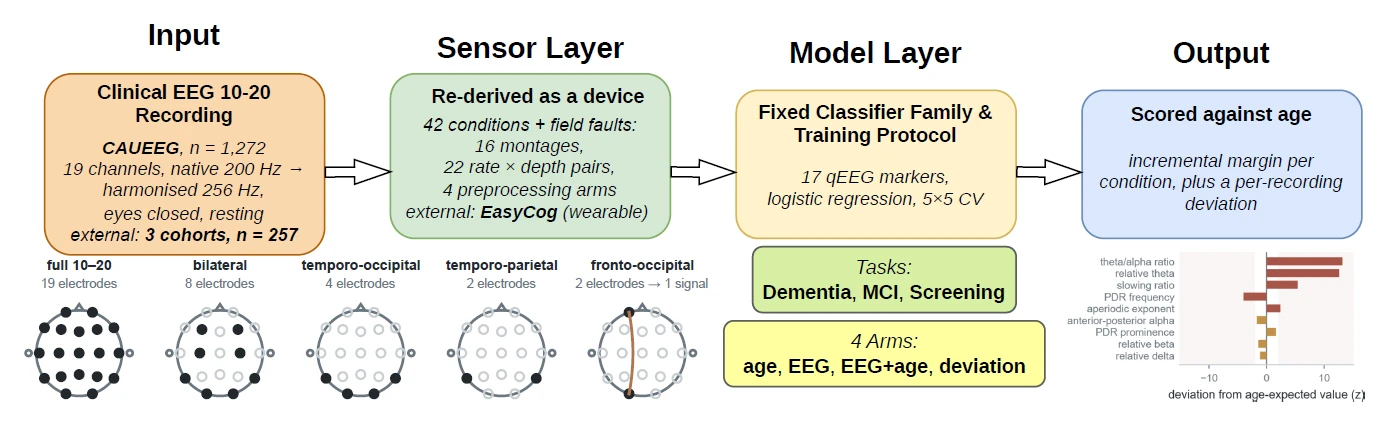
Decomposing a clinical EEG montage for low-channel cognitive triage
In recordings re-derived to simulate low-channel devices, a few well-placed electrodes screened for cognitive impairment about as well as a full clinical EEG. This points towards simpler screening devices, which still need testing as real hardware.
Short cognitive tasks that run offline on a phone or laptop and track changes in
each person over time. Designed to support screening, not to diagnose.
 Hridae